
Voice search is growing rapidly across the GCC, driven by high smartphone penetration, widespread smart speaker adoption, and the convenience of hands-free querying in Arabic. Google reports that Arabic content drives 65% of high-engagement posts in Saudi Arabia, and voice queries are disproportionately Arabic because speaking feels more natural than typing in a second language.
But optimizing for voice search requires a fundamentally different approach than traditional keyword-based SEO. When someone types, they write "best web design agency Dubai." When they speak, they ask "what is the best web design agency in Dubai for e-commerce?" These are different intents, different content structures, and different optimization strategies. At CodeStan, we have helped clients across Riyadh, Jeddah, and Dammam adapt their content for this conversational shift.
How Voice Search Differs from Typed Search
Voice queries are longer, more conversational, and typically framed as questions. Data from Google's MENA search insights reveals:
- Voice queries average 7-10 words compared to 2-3 words for typed queries
- Question words (what, where, when, how, why, who) appear in 62% of voice searches
- Voice searches have higher local intent — "near me" queries grew 146% in Saudi Arabia between 2024 and 2026
- Arabic voice searches often mix code-switching (Arabic + English words), especially for technical and brand terms
For a Dubai real estate client, we discovered that voice searchers asked "what are the best off-plan properties in Dubai under 2 million dirhams?" rather than typing "Dubai off-plan properties 2M AED." This insight reshaped their entire content strategy.
The Arabic Voice Search Landscape
Arabic NLP (Natural Language Processing) has improved dramatically, but it still presents unique challenges:
- Dialect diversity: A voice query in Saudi Najdi dialect differs significantly from Egyptian or Levantine Arabic. Google's models now handle Gulf Arabic (Khaliji) better than ever, but Modern Standard Arabic (MSA) content still ranks highest.
- Diacritical ambiguity: Arabic text without diacritics (tashkeel) can have multiple meanings. Voice search engines are improving at inferring intent from context.
- Right-to-left processing: Voice assistants must parse Arabic syntax correctly, which differs fundamentally from English subject-verb-object structure.
- Code-switching normalization: Queries like "افضل web design agency في دبي" require engines to understand both languages simultaneously.
A Dubai real estate client discovered voice searchers asked "what are the best off-plan properties in Dubai under 2 million dirhams?" rather than typing "Dubai off-plan properties 2M AED." This single insight reshaped their entire content strategy and doubled their organic voice traffic in 90 days.
Conversational Content Strategy for Voice SEO
1. Structure Content as Question-Answer Pairs
Google's featured snippets and voice search results overwhelmingly pull from content that directly answers a question. The format that works:
- Clear H2 heading phrased as a question ("How much does a website cost in Dubai?")
- Direct answer in the first 40-60 words of the section
- Supporting detail, examples, and data below the direct answer
For a Riyadh healthcare client, we restructured their service pages around patient questions. "What is the recovery time for LASIK surgery?" became an H2 with a 45-word direct answer, followed by detailed explanation. They captured 12 featured snippets within 90 days.
2. Target Long-Tail Conversational Keywords
Traditional keyword research tools undercount voice queries because they rely on typed search data. Supplement with:
- Google's "People Also Ask" boxes for your core keywords
- AnswerThePublic.com for question-based query variations
- Your own customer service chat logs and FAQ emails
- Google Search Console query reports filtered for question words
High-opportunity voice keywords for GCC businesses:
- "what is the best [service] in [city]?" (e.g., "what is the best CRO agency in Dubai?")
- "how much does [service] cost in [country]?" (e.g., "how much does website design cost in Saudi Arabia?")
- "where can I find [product] near me in [city]?"
- "how to [action] for [business type] in [country]?"
3. Build Comprehensive FAQ Pages
FAQ pages are voice search goldmines when structured correctly. Best practices:
- Use FAQ schema markup (JSON-LD) so Google can directly extract question-answer pairs
- Keep answers concise: 40-60 words for voice search, with expandable detail for users who want more
- Group questions by topic cluster, not random order
- Include both Arabic and English versions for bilingual audiences
- Update FAQs quarterly based on new customer questions
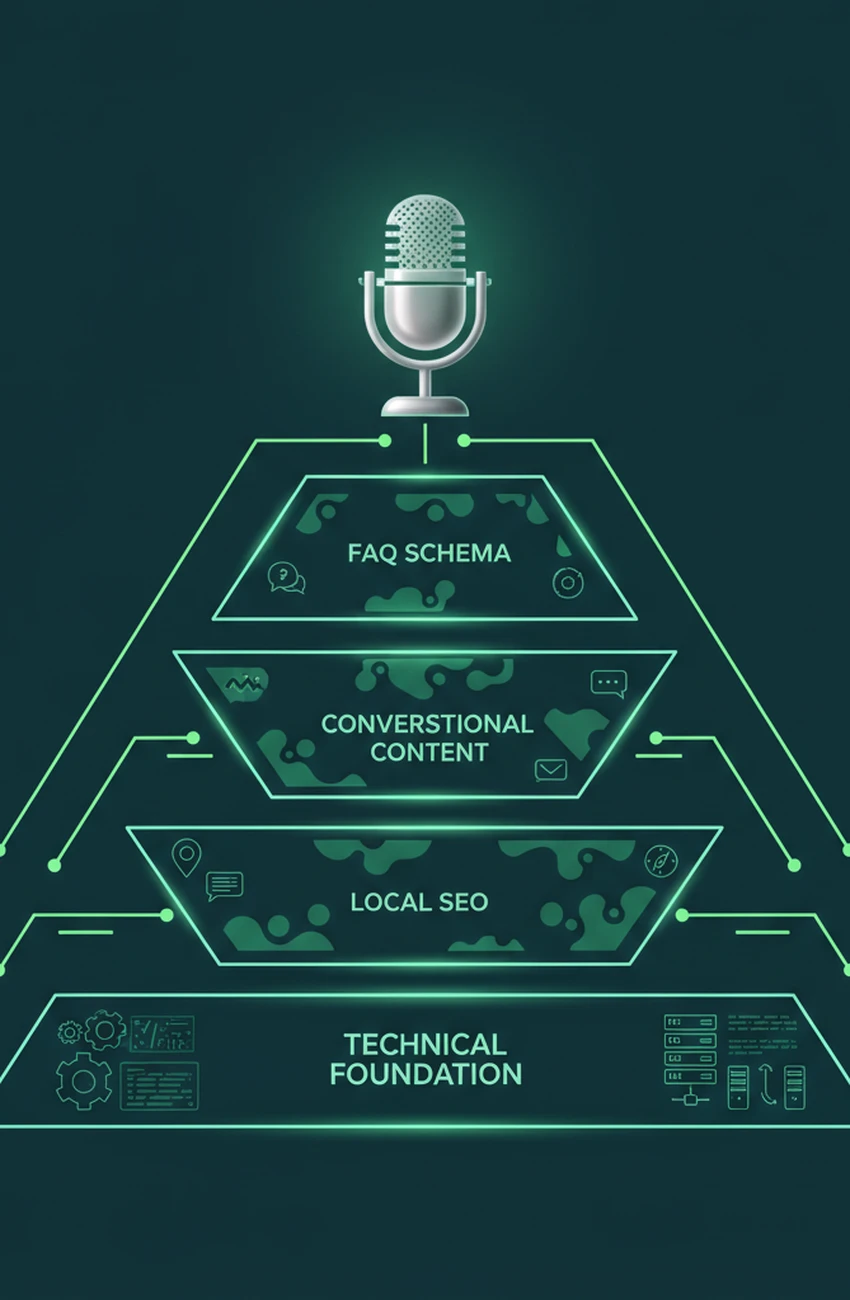
Local SEO and Voice Search: The GCC Advantage
Voice searches have exceptionally high local intent. "Near me" queries are predominantly voice-driven. For GCC businesses, this means:
- Google Business Profile optimization: Ensure your profile is complete, verified, and regularly updated with posts, photos, and Q&A responses in Arabic and English.
- Local schema markup: Use LocalBusiness schema with precise geo-coordinates, opening hours, and service area definitions.
- Location-specific landing pages: Create dedicated pages for each city you serve (Dubai, Abu Dhabi, Riyadh, Jeddah, Dammam) with localized content, not just duplicate pages with swapped city names.
- Arabic reviews: Encourage customers to leave Google reviews in Arabic. Voice assistants often cite review content when answering local queries.
For a Jeddah restaurant chain, optimizing for "best Saudi breakfast near me" voice queries increased organic local traffic by 67% over six months.
Technical Voice SEO Implementation
| Technical Factor | Target | Impact on Voice Results |
|---|---|---|
| Largest Contentful Paint | < 2.5 seconds | Critical — slow pages rarely win voice |
| Mobile-first indexing | Perfect RTL on mobile | Required for Arabic voice queries |
| HTTPS | Valid certificate | Non-negotiable baseline |
| FAQ schema markup | JSON-LD on all FAQ pages | Direct voice answer source |
| Core Web Vitals | Pass all three metrics | Required for featured snippet eligibility |
Beyond content, technical foundations determine whether your site qualifies for voice results:
- Page speed: Voice results overwhelmingly come from fast-loading pages. Target LCP under 2.5 seconds.
- Mobile-first indexing: Google uses your mobile site for all indexing. Ensure Arabic RTL renders perfectly on mobile.
- HTTPS: Non-negotiable for any site that wants to rank in 2026.
- Structured data: Beyond FAQ schema, use HowTo, LocalBusiness, Product, and Review schemas where applicable.
- Core Web Vitals: Pass all three metrics (LCP, FID, CLS) to remain competitive for featured snippet and voice result placement.
Key Takeaways
- Voice queries are 7-10 words, question-based, and have higher local intent than typed searches
- Arabic voice search is growing fastest in Saudi Arabia and the UAE, with significant code-switching
- Structure content as question-answer pairs with direct answers in the first 40-60 words
- FAQ schema and comprehensive FAQ pages are the highest-ROI voice SEO tactics
- Local SEO (Google Business Profile, local schema, Arabic reviews) is inseparable from voice search success in GCC markets
Want to capture more voice search traffic? Get a free SEO audit from CodeStan. We analyze your current content structure, technical SEO, and local search presence across Saudi Arabia and the UAE.


